
Cart
0
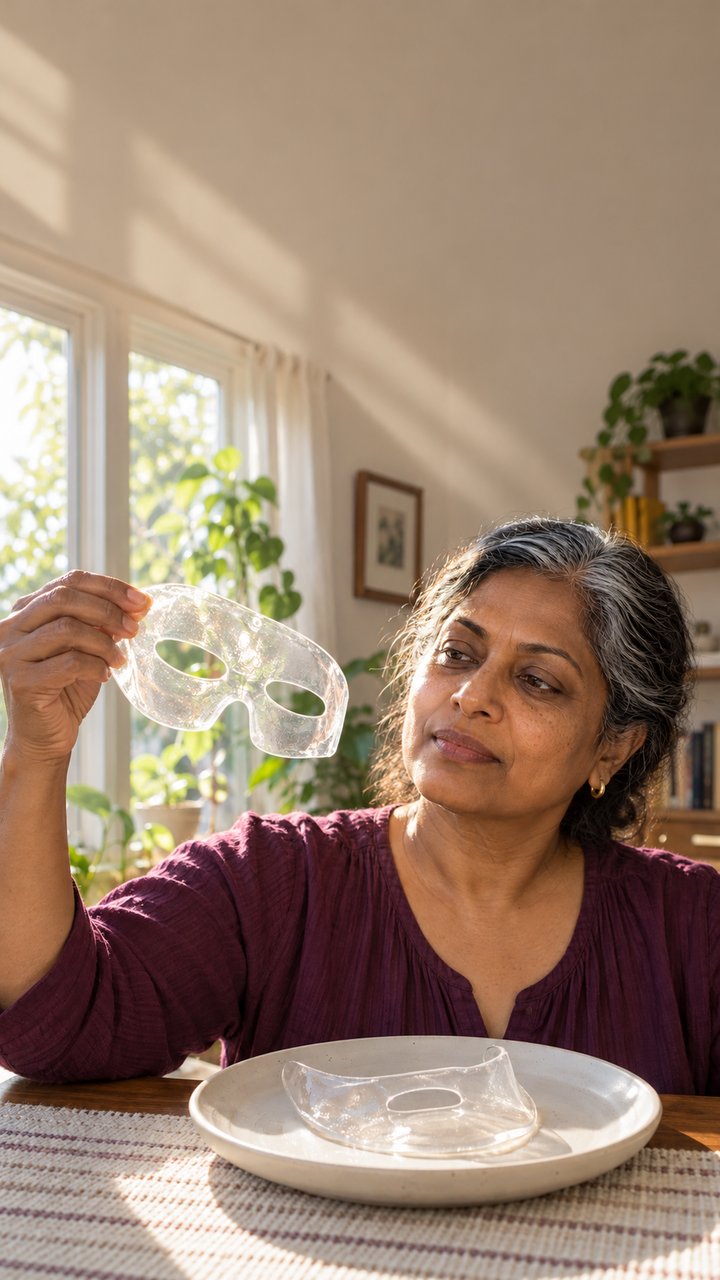
Quick answer: A hydrogel collagen mask turns clear as serum leaves its gel network through skin contact and evaporation, making the gel thinner and less able to scatter light. This usually takes 3–4 hours; transparency helps time removal, but does not prove collagen has reached deep skin layers or rebuilt collagen.
If you've seen the videos, you know the moment: someone peels off a mask that went on milky white and comes off almost as clear as glass. It's oddly satisfying, and it's a big part of why hydrogel collagen masks went viral.
But what's actually happening? Is the clearing a sign the mask "worked", or just a clever bit of packaging? Let's break it down simply.
What a Hydrogel Mask Is Made Of
A hydrogel mask is a soft sheet made of a gel network, a bit like a very thin, flexible jelly. That network holds a large amount of liquid serum in tiny pockets.
In a collagen mask, that serum usually contains:
- Water, the main ingredient
- Collagen or collagen peptides
- Humectants like glycerin and hyaluronic acid, which attract and hold water
- Supporting actives such as niacinamide, ferments or plant extracts
- Ingredients that keep the gel stable and the formula fresh
Our explainer on what bio-collagen is goes into the collagen part in more detail.
Why It Starts Out Cloudy
When the mask is fresh out of the pack, its gel network is packed with serum. Light hitting the mask bounces around inside all those liquid-filled pockets and the dissolved ingredients. That scattering makes the mask look cloudy, milky or opaque, the same reason a glass of water with a little milk looks white.
Why It Turns Clear
As the mask sits on your face, two things happen:
- Your skin takes in some of the serum. The top layers of your skin are thirsty, especially at night. Water and humectants move from the mask into those layers.
- Some of the water evaporates from the outer surface of the mask, slowly, because hydrogel holds on to moisture far better than cotton.
As serum leaves the gel, there's less material inside to scatter light. The gel thins out, and the mask becomes more and more see-through.
The result: a mask that started cloudy ends up almost transparent.
Does Clear Mean It "Worked"?
Mostly, yes. The clearing is a practical, visual sign that serum has moved out of the mask, much of it into your skin. That's why it's a useful timer: when the mask is mostly transparent, you've had most of what it has to offer.
But it's worth keeping expectations realistic:
- Clear doesn't mean collagen has entered deep into your skin. Collagen molecules mostly stay in the upper layers and on the surface, where they help hold water. The visible "glow" comes from hydration.
- Some of the change is evaporation, not absorption. That's normal and expected.
- A mask that stays partly cloudy hasn't failed. Thicker edges, and areas that weren't pressed flat against your skin, often stay cloudy.
Why Some Areas Stay Cloudy
Totally normal. The usual reasons:
- Edges are thicker and don't touch the skin as closely.
- Air bubbles under the mask stop that area from transferring serum.
- Bony areas like the bridge of the nose and the jawline have less contact.
- The area around the mouth moves when you talk or yawn, breaking contact. For other application issues, review these collagen mask mistakes.
To get a more even result, press the mask flat from the centre outward when you apply it, and smooth out any bubbles.
How Long Does It Take to Turn Clear?
Usually three to four hours, sometimes longer. It depends on:
- Your skin's hydration. Very dry skin tends to draw serum faster.
- Room conditions. AC and fans speed up evaporation; humid rooms slow it down.
- Mask thickness and how much serum it holds.
If you're wondering whether to leave it on longer or take it off, see how long to leave a collagen mask on.
Do Sheet Masks Turn Clear Too?
Not really. Cotton and fibre sheet masks are already semi-transparent when wet, and they simply dry out and stiffen as the essence evaporates. Hydrogel's cloudy-to-clear change is unique to its gel structure, which is one of the reasons people find hydrogel masks easier to time. More differences are covered in hydrogel vs sheet masks.
Is a Clear Mask Safe to Keep On?
Yes. Once it's clear, there's little serum left, so there's no benefit in keeping it on, but no harm for most people either. If you're wearing it overnight and wake up to a clear mask, just peel it off and pat the leftover serum into your skin.
Why Hydrogel Doesn't Dry Out Like Cotton
The secret is in how the water is held. In a cotton sheet mask, liquid simply soaks into the fibres. It's free to evaporate from every surface, so the sheet dries out in 20–30 minutes.
In a hydrogel, water is trapped inside a three-dimensional gel network, a bit like water held in a sponge made of microscopic strands. That network releases moisture slowly and evenly. The outer surface loses some water to the air, but the layer touching your skin stays moist for hours.
That slow, steady release is what makes long wear possible and the gradual cloudy-to-clear change visible. It's also why a hydrogel mask feels cool for so long. Water evaporating from its surface carries a little heat away with it.
Myths About the Clearing Effect
Myth: "The clearer the mask, the more collagen you've absorbed." The clearing mostly reflects water and humectants leaving the gel. It's a good sign of hydration, not a collagen meter.
Myth: "If it doesn't turn clear, the mask is fake." Room conditions, fit and skin type all affect clearing. A partly clear mask can still have done its job.
Myth: "A clear mask can be reused." Once the serum is gone, the gel has nothing left to give. Hydrogel masks are single use.
Seeing It for Yourself
The Nova Bloom Bio-Collagen Overnight Glass Skin Mask shows this change clearly. It goes on cloudy and becomes transparent as your skin absorbs the serum, whether you wear it overnight or for three to four hours. Inside: collagen peptides, hyaluronic acid, niacinamide, galactomyces and centella.
A Simple Experiment You Can Try
Curious how much your environment matters? On two different mask nights, try one with the fan or AC on and one with it off (if the weather allows). Note what time you applied the mask and roughly when it turned mostly clear. Many people find the mask clears faster with moving air because more water evaporates from the outer surface. It's a fun way to understand your mask, and it helps you choose the best conditions for your skin. Slower clearing with less airflow usually means more of the serum went into your skin rather than into the room.
Frequently Asked Questions
My mask turned clear in two hours. Is that normal?
Yes, especially in a dry or AC room, or if your skin was very dehydrated. Peel it off and pat in the remaining serum.
My mask is still cloudy in the morning. What happened?
Possibly a humid room, a loose fit, or a mask that moved in the night. Your skin still received serum where the mask touched it.
Does the mask shrink as it clears?
It can get slightly thinner and lighter, but it shouldn't shrink much. If it becomes stiff and dry, it lost moisture before use, perhaps from heat during storage.
Short on time? Flip through the 8-slide visual version of this guide.
Sources
- Benefits of topical hyaluronic acid for skin quality and signs of skin aging: From literature review to clinical evidence – Dermatologic Therapy (PMC)
- Emollients and moisturisers – DermNet
Watch the change for yourself. Try the Nova Bloom Bio-Collagen Overnight Mask for ₹299, with cash on delivery across India.

